
If it’s something that is worth doing, then it’s worth doing it badly.
It’s a bold statement, especially in a world where we value perfection. But here at Strategy Toolbox we’re believers that one of our biggest barriers to getting started, or finalizing the implementation, is the perspective that it needs to be done properly, to be done well, maybe even perfectly.
It can feel like Business culture frowns on shortcuts and sticky-plaster solutions. You’ve heard ‘do it once, do it right’ or ‘prioritize quality over quantity’ but honestly, we disagree. When you think about the pace of change, the huge number of opportunities and the lack of time to do it all, then realistically things that are truly worth doing, that are really going to add value – they’re probably worth doing even if you only do a pretty average job of them. There are a few exceptions to the rule of course, but this post will help you become a pro at doing a bad job.
So let’s get into it, we’ll cover off when you should do things badly, how to do things badly and give you some tips on areas of your business that offer great starting points.
What do we mean by doing something badly?
When we talk about doing something badly, what we really mean is focusing in on the parts that truly matter. Doing something “well” often entails ensuing everything is completed to a high standard, that we tick all the boxes, ensure that we cover all bases. But in a time-constrained world, this isn’t the best use of our time. So taking shortcuts, using sticky-plaster solutions, leaving things out and calling it “good enough” unlocks the opportunity to shift our focus onto the next burning topic.
This idea of doing things badly is nothing new, it’s just been hidden in technical language. The Pareto Principle has been around since the 1940s, dictating that only 20% of work gains you 80% of the value. More recently, agile methodology has expressed its love of a ‘minimum viable product, ‘ which means creating software that is unpolished and developed only to the point of being usable. We’ll delve into these ideas a bit deeper below.
When should you do things badly?
As we said, there are exceptions to the rule – there will be some cases where doing something badly can be detrimental rather than helpful. So we’ve pulled together some questions to ask yourself before you double down on putting in an average amount of effort.
Is this worth doing at all?
If it doesn’t pass this question, forget about it and pick something else! So how do you know is something is worth doing?
Three questions to ask to know if something is worth doing?
1. Does the value gained (cost saving, revenue gaining, risk reducing etc) outweigh the cost of doing it (financial investment, effort, added complexity etc).
2. Are you addressing the problem? A root cause analysis, 5-Whys or Ishikawa, is great for understanding root causes and symptoms of a problem. Are you actually addressing them?
3. Is it aligned with your strategy? Opportunities are endless, sometimes you’ll have to say no to a good thing. Does this align with what you want from your business?
Consider the associated Risks?
We need to be careful when there are risk factors at play. All changes are disruptive in some way or another so you need to be clear on the risks you’re willing to take as well as account for them when deciding your “do it badly” approach.
Four Risks to consider when planning your changes:
- Safety: This one is non-negotiable, if it has the potential to cause a safety hazard, do it properly, invest the time.
- Brand Image: Your brand-image is too important to risk on shortcuts. This isn’t to say you can’t apply these concepts across your marketing and public activities, but you need to be clear on the risks and how you’re minimizing them.
- Quality: The quality of your product, service or processes can be impacted. Sometimes this is a tactical & strategic tradeoff, but be sure you know what the outcomes might be.
- Financial: How much financial risk you take will depend on your business context, your risk appetite and potential pay-offs from the change.
Three ways to do things badly:
Doing things badly means thinking strategically about what really matters and focusing our actions on just these items. We’ll show you three ways to achieve this, each tailored to a different type of challenge.
Chunking & Segmentation:
First up we’ll talk about chunking things down and focusing on only a small area. This approach can be paired with the others to help really zone in on what matters. Chunking and segmenting your problem is a great way to identify different areas you can address.
Our Top Four Ways to Slice your Business into manageable parts:
1. Customer Demographics / Groups : Want to increase your customer satisfaction? Grouping your customers can help you zone in on the group with either the biggest room for improvement in satisfaction or the one that will translate into the biggest gains in revenue as satisfaction increases.
2. Product or Product Category: Getting a lot of customer complaints about quality? Instead of trying to address this at a holistic level, figure out which products are getting the most complaints overall.
3. Process Steps: Trying to automate your sales process but getting overwhelmed? Chunk it down into stages, which one is the most time heavy? Focusing on getting just this one step automated or partially automated.
4. Relative Risk: Does your lack of training documents have you worried? Getting operating procedures created for everything in your business can be a huge undertaking. Focus on high risk areas and get the basics noted down. Areas relating to legislation, finances and security are often critical areas to focus on.
When you choose to only implement an improvement to a small area of your business you can consider it doing a ‘bad job.’ Conventional thinking would say that if you’re going to do it at all, do it properly and apply it throughout. But there’s so many benefits to doing it this way instead; fast results, lower risk and learning lessons that you can apply later.
Pareto: The 80:20 Rule
The Pareto approach, also called the 80:20 rule suggests that 80% of the value comes from 20% of the effort, In other words, 80% of what you do barely makes a difference & is probably a waste of time. Conceptualized by an economist, Vilfredo Pareto, this principle is a favourite for optimisation specialists. When it is applied correctly it can help you zone in on what really matters, whether it’s allocating your advertising spend on the most profitable customers or giving your most annoying clients the flick.
3 examples of the Pareto Effect in your business & life:
- 80% of your customer complaints come from only 20% of your products. Go and read the google reviews for your local cafe – you’ll see that despite having 30 or more food & drink items for sale, there’s just a few food or beverage items that are mentioned in the majority of negative reviews, whether it’s a burger with slim toppings or the coffees coming out cold.
- 20% of your products are generating 80% of your revenue. The majority of your products aren’t driving your profitability, if you boil it down you’ll find that only 1 in 5 products is having a significant impact on your revenue, whether that’s through high sales or high profit margins.
- You’ve got visitors coming over in a few hours and the house is a mess! You can make the house look 80% better by only cleaning or tidying up 20% of the things. Put away the laundry, vacuum the living space & wash the dishes. The other 80%, e.g. dusting, mopping, cleaning the windows, will not only take longer but will not have the same level of impact.
How to apply the Pareto Principle to your Business
So how do you figure out what that 20% is? We’ve got two approaches below. We’ll show you how run the analysis correctly, but we’ve also got the intuitive option. The intuitive approach isn’t how you do it properly but it is how you do it badly, and if it’s worth doing, then it’s worth doing badly, right?
1. Intuitive: Set a tight deadline: Parkinson law dictates that work will expand to fill the time allocated to it, so simply setting a tight deadline can help motivate you to zone in on that 20% of effort. If you’re making a presentation and you’ve only got an hour to complete it, you know you won’t get distracted with aesthetic designs beyond making it tidy enough to present. This approach is great for day to day application where diving into the data doesn’t make any sense. You can also use Prioritisation matrixes which we present later in the blog.
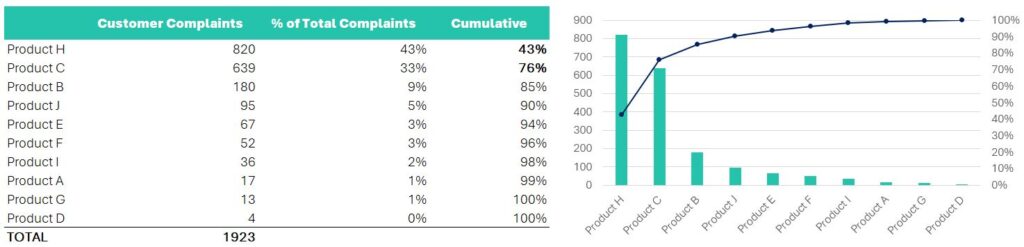
2. Analytical: Run the numbers: Create a simple table of your data & sort by highest to lowest. Highlight the top items until you reach 80%. You can also put the data in a graph to visualise the relationship. In this example, we can see that two of the Products H & C are causing 76% of the customer complaints. This may be because they’ve got the highest sales, lowest quality or a range of other reasons. But rather than focusing on 10 products to drive down customer complaints, you can instead zone in on just reducing these two.
Minimum Viable Product
Minimum viable product comes from agile methodology and is used heavily in software development. It is the idea of creating something barely usable to start and then using feedback to refine, improve and optimise it over time. This approach tries to address over-engineering a product or solution only to find out it doesn’t meet user needs. It also has the benefit of getting a product out to the user much quicker, rather than waiting for all functionalities to be available. Just like Pareto though, you’ll need to spend some time before you start to understand what components a minimum viable product includes.
MoSCoW Approach
When you’re designing your minimum viable product, a MoSCoW approach is a great way to get clear on what good enough looks like. This method challenges you to categorise all your ideas, possibilities and functionalities into four categories.
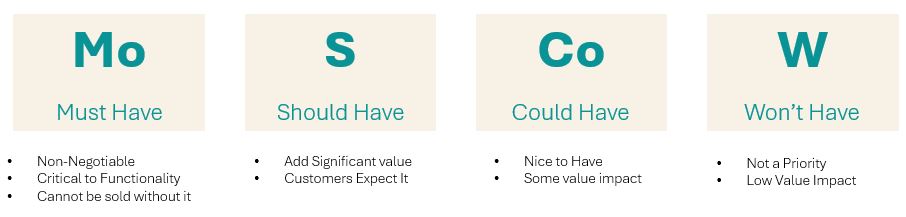
Once you’ve broken down your features into these four categories, it’s time to decide just how badly you want to create your product. If we apply the Pareto principle, only 20% of the features will generate 80% of the value and these will almost certainly come from the Must Have category. By limiting your first pass at a product or project to only the Must Haves and a sprinkle of the Should haves you’ll significantly cut down the time you spend and still create significant value for your business.
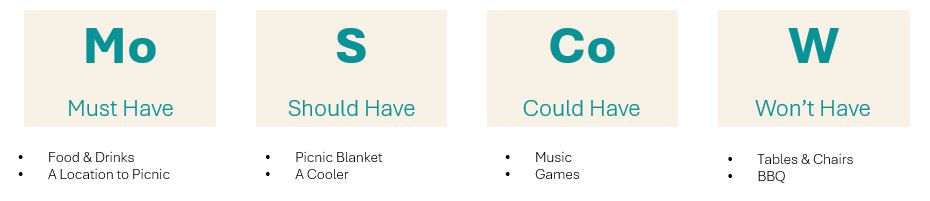
Lets use this example for a Picnic. It’s not really a picnic if you don’t have something to eat & drink or somewhere to go. It’s going to be a lot nicer if you’ve got a blanket to sit on and a cooler for your drinks. It would be nice but not necessary to have some music and games but the BBQ or tables & chairs aren’t going to make the cut. Depending on how badly you’re willing to make your picnic you can simply stop at the Must Haves and call it a day.
Our top 5 areas to try the ‘do it badly’ approach:
So what parts of your business can you apply this ‘do it badly’ tactic? We’ve talked about managing risk, but here’s our top 5 places to start looking for some opportunities to do a bad job.
1. Product Quality Improvements: Use pareto to understand where your issues are, do a root cause analysis on the main causes, use a prioritisation matrix to identify some quick wins. Implement, check its working.
2. Reporting & data analysis: Pick a few things to measure that represent big risk and big opportunity. Ask yourself, would a bad result on this get me taking swift action? If not, don’t bother measuring it.
3. Innovation: Fail fast, churn out a high number of products, ideas and tests to see how the market responds. This invaluable data can help you refine the winning products into what the customer truly wants
4. Strategic Planning: it’s better to have a half cooked plan than no strategy at all! Start at a holistic level and chunk your business into areas you’d like to improve. Pick one with the most potential and go deeper in just this area to get yourself started.
5. Action Management: Getting a strong action planning methodology in place is immensely useful but can be a tough challenge to get running smoothly. Start with a simple to do list that you’re using consistently and then make it 1% better everyday, slowly bringing in deadlines, priorities, strategy and time management principles.
Go get started on doing things badly!
If you’ve read this far, you’re probably doing too much – you’ve likely already gotten 80% of the value from this blog! So get on with it and go do some things badly. Remember; progress over perfection, near enough is good enough, go fast & fail often.