
It’s that time of year when we start making resolutions of how we’ll evolve and change for the better once the fresh year starts. These resolutions can be helpful or harmful depending on what they are and how you phrase them, so here at Strategy Toolbox we’ll help you make resolutions that will lead to a better 2026.
While we absolutely support the use of SMART goals to achieve results in your business, we believe that New Year’s resolutions should focus more on the underlying ways of thinking and behaviours that unlock your ability to deliver on your goals. So we’ve outlined three unique ways to transform your ways of thinking which in turn will transform your business for the better.
Enjoy more Leisure time, that is actually Leisure:
What do we mean by this? If you’ve read some of our other content, you’ll know that we have a work-to-live not live-to-work attitude, yet what we see is hustle and productivity sneaking into every aspect of our lives. In 2026 we want to see you set time aside more time for true leisure, not hustle disguised as leisure. While there are absolutely activities that we enjoy that also progress our business goals, it’s important to truly disconnect and just enjoy the moment.
Five sneaky examples of true leisure vs hustle disguised as leisure:
- Going for a walk: True leisure is talking a stroll to enjoy being outside, get some fresh air and make your body feel good. Hustle disguised as leisure is targeting your 10k daily step count while listening to an informative podcast.
- Social Media: True leisure is enjoying some content that makes you feel happy or intrigued. Hustle disguised as leisure is doom-scrolling to avoid an impending deadline or engaging on your business account to chase more followers
- Reading a book: True leisure is diving into a few pages of a book that is making you feel happy or intrigued. Hustle disguised as leisure is reading extra pages to tick off more books, reading non-fiction related to your business, or reading to be able to tell others
- Hobbies: True leisure is pottering away at your hobbies and getting into a state of flow. Hustle disguised as leisure is monetizing your hobbies, setting deadlines relating to your hobbies or using your hobbies to save cash.
- Socializing: True leisure is enjoying each others company and creating new memories together. Hustle disguised as leisure is completing your ‘friendship hygiene’ of generic updates on each-others lives, sending a message because ‘it’s been a while’ or mixing your catch-ups with productive activities (like hitting you 10k steps)
We’re not saying you should never engage in some hustle disguised as leisure, it’s a great way to make work feel fun. However we all need to be more aware of setting time aside for true leisure, to really refresh ourselves and to reset our minds. We need to shift away from every activity in our lives needing to ‘add value’ or be productive in some way shape or form.
Dedicate time to improvements:
You’ve got great intentions now of all the things your going to change and improve across your life and business, ideas are flowing and everything feels achievable, we love to see it! What we don’t love to see is reality slowly distracting people away from their ideas and back to the daily grind. You can read our post about how the time will never be right to get started, we promise that your to do list will never be empty enough for you to magically have time to sit down and take action.
Three ways to take action:
- Create Accountability to your plan: It can be as simple booking a monthly self-check-in in your calendar where you plan what you’d like to do for the next month and reflect on what you actually achieved last month. Getting an accountability buddy is even better, find someone in your network that you can have regular check-ins with. One study showed that sharing a goal with someone can increase your likelihood of success by 65% and if you have regular check-ins this increases to 95%.
- Have a prioritized list of Improvements: It’s going to be easier to get started if you know where to put your focus. Take the time to list all of your improvement ideas and their relative payoff (effort vs reward). Having this list easily accessible will help you to get started on these ideas rather than taking the path of least resistance and focusing back on your day to day tasks.
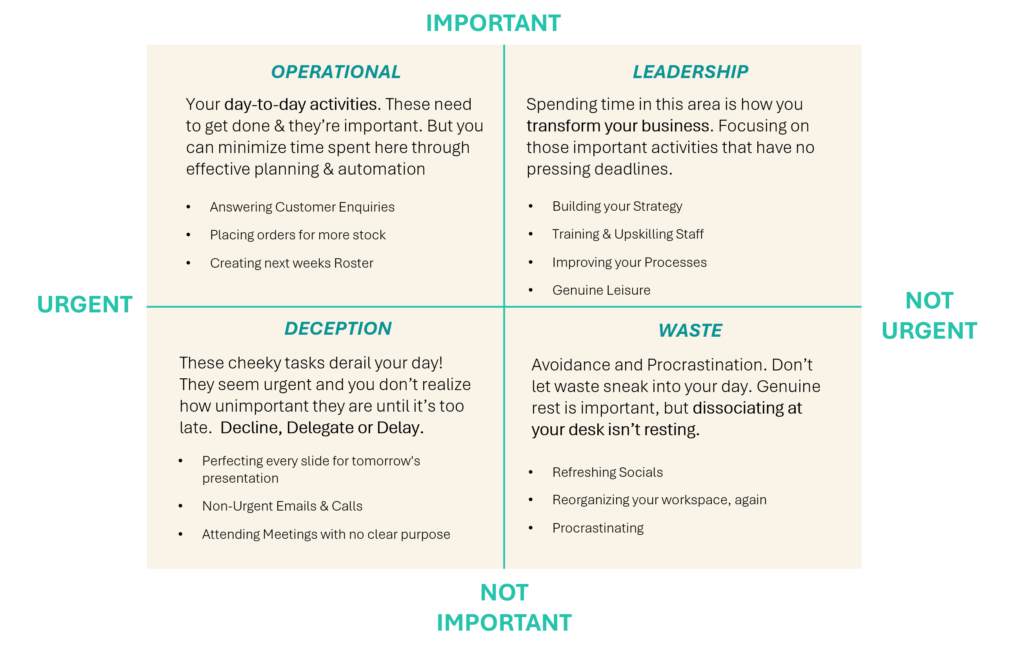
- Reflect on how you spend your time: Understand where your time is going and find opportunities to choose ‘Leadership’ activities instead of getting sucked into fighting more fires or using doom-scrolling to try and address your anxiety about a problem
Ask “Why” more often:
Whether it’s setting your New Year’s Resolutions or deciding where to invest, getting clear on why something matters will change your business approach. When the sparkly new year feelings of opportunity fade and the daily grind takes over it can be easy to keep doing it the way you always have. We propose that you set a resolution to begin asking “why” for each business activity you are undertaking.
Five ‘Why’ questions to ask in your business:
- Why does my business exist? Starting with the big question, what are you actually in the business of? Go beyond your product or service. If Blockbuster realized they were in the business of providing access to entertainment rather than physical movies then maybe they could have competed with Netflix. Know why you offer the products & services you do, and
- Why is this activity valuable to my business? Reframing each task as generating some kind of value can help immensely with prioritization. Some of the answers will be ‘for reward’ and others will be ‘to avoid pain.’ Why do you do your taxes? Why are you running a report on your earnings? Why are you replying to this customers email? How is it progressing the goals of your business.
- Why do we do it this way? As your business grows and evolves processes, documents and ways of working come along for the journey. It can be easy to continue following certain steps because ‘that’s the way we’ve always done it,’ but take the time to ask yourself why you are working the way that you are. In many cases the processes may still make sense, but you might just find some opportunities to add to your list of improvement ideas.
- Why does a stakeholder think/do that? Are you in the habit of accepting stakeholders actions because ‘they’re out of your control’? Whether it is the packaging a supplier uses, a clause in a contract or a customer’s specific requirements. Asking that stakeholder ‘why?’ can open a dialogue where worst case nothing changes but you understand why it is that way, or best case you can work with the stakeholder to find a way that works for both of you.
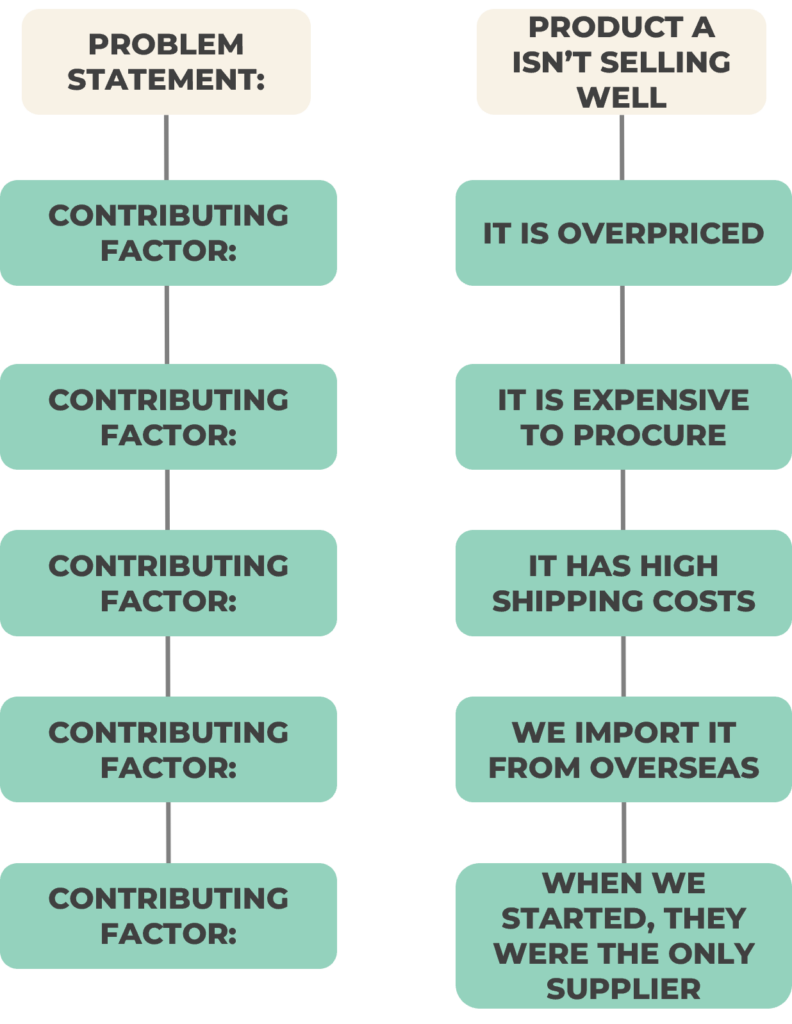
- Why is this problem occurring? Often the problems we see are actually symptoms of a less obvious root cause, addressing the problem you see will only make a small or short-term impact before the unaddressed root-cause creates some more havoc. In this case, we recommend asking ‘why’ five times to understand where the issues are actually coming from. Based on your 5-Whys you should have some strong starting points to begin addressing root-causes. In the example below it would be easy to invest more in advertising your product when actually you should be chasing down a local or lower cost supplier.
Make 2026 your year of Success:
Equipped with these three resolutions, you’ll make significantly more progress than setting traditional resolutions. These will change the way that you think and how you operate in your business every day. These three resolutions address three areas small businesses often struggle with:
- Finding work life balance: Part of the challenge is that you aren’t giving yourself permission to truly relax, so even when you’re not working, you’re undercover working.
- Making genuine change: The daily grind will suck you right back in and this time next year you’ll be setting the same goals. Dedicating time to work on your ideas and holding yourself accountable will help you to make those ideas a reality.
- Strategic thinking: Asking Why more often will transform the way you think about your business and make strategic thinking your default setting. Don’t take things at face value, ask why.
So it’s time to get started, we recommend that the first order of business is to go and enjoy some true leisure time (and no, reading this blog does not count)!